+86-18058825678
- All
- Product Name
- Product Keyword
- Product Model
- Product Summary
- Product Description
- Multi Field Search

- Home
- Our Product
- About Didtek
- Solutions
- Exhibition Show
- Support
- News
 English

Views: 0 Author: Site Editor Publish Time: 2026-06-08 Origin: Site


You use an api 6d gate valve to stop or start liquid flow in pipelines. This valve gives a strong shut-off. This is important for safety and smooth work. Didtek makes good gate valves for oil and gas, medicine, and ships. API 6D compliance is important because it helps keep pipelines safe and working well.
Valves made to API 6D standards help stop problems and cut down on breaks.
These valves give a tight shut-off and last a long time.
When you work with pipelines, you hear about api 6d gate valve. The api 6d standard gives rules for making and testing these valves. These rules help you trust the valve in hard situations.
The api 6d standard has many important rules. Look at the main points below:
Material Specifications
Body and bonnet materials must handle high pressure and tough places.
Sealing materials must stop leaks and stand up to chemicals and heat.
Bolting and fasteners must be strong for safety.
Trim materials must fight damage and rust.
Non-pressure parts must use strong materials.
Construction Standards
Welded and flanged connections must stay strong when under pressure.
Pressure boundary design keeps the valve safe during use and tests.
Casting and forging must follow api rules for good quality.
Strength and toughness protect against outside forces.
Quality control means careful tests during making.
These rules help your api 6d gate valve work safely and last longer.
A gate valve helps you control liquid flow in a pipeline. The design lets you open or close the flow by moving a gate up or down. When you turn the handle, the gate goes up and fluid moves through. If you lower the gate, it blocks the flow. This action gives a strong shut-off and stops leaks.
Here is a table showing common materials used in api 6d gate valve construction:
Material Category | Common Materials |
|---|---|
Body and Bonnet Materials | Carbon steels, stainless steels, alloy steels |
Sealing Materials | Gaskets, seals, packing |
Bolting and Fasteners | Carbon steel, corrosion-resistant bolting |
Trim Materials | Stainless steel, high alloys |
Non-Pressure Boundaries | Durable materials for supports and accessories |
You pick these materials because they help the valve fight rust, pressure, and damage.
Your api 6d gate valve must meet strict rules. Didtek makes sure every valve follows api 6d rules and passes many tests. You can see Didtek’s certifications in the table below:
Certification Type | Description |
|---|---|
API6D | Meets api 6d standards |
ISO9001 | Quality management system certification |
Lloyd's CE Model H | European conformity certification |
CU TR-32/010 | Meets Russian technical rules |
API6FA | Fire protection certification |
API607 | Fire test for valves certification |
Didtek builds api 6d gate valves for oil, gas, ships, and more. You get a valve that meets world standards and keeps your work safe. You can trust Didtek to give you reliable products that follow api 6d rules.
An API 6D gate valve has many important parts. Each part helps the valve work well and stay safe. The stem, gate, body, bonnet, and sealing surfaces all help control flow. These parts also keep the system safe. Didtek makes wedge, slab, and pressure seal gate valves. Each type is made for a special job.
Here is a table that shows how design and materials change how the valve works:
Aspect | Description |
|---|---|
Sealing Mechanisms | Different sealing types, like metal-to-metal or soft seats, change how tight the seal is. |
Body and Bonnet Materials | Carbon steels and stainless steels can handle high pressure and heat. |
Trim Materials | High alloys and stainless steel stop wear and rust in trim parts. |
Full-Bore Design | The valve lets fluid move easily because its diameter matches the pipeline. |
You can see that picking the right materials and design helps the valve last longer and work better.
You control the flow by moving the gate inside the valve. The rising stem lets you see if the valve is open or closed. When you turn the handwheel, the stem goes up. This lifts the gate and lets fluid pass. Lowering the stem blocks the flow. This makes it easy to see if the valve is open or shut. It also lowers friction inside the valve.
Here is a table showing features of the rising stem mechanism:
Feature | Description |
|---|---|
Visual Confirmation | You can see if the valve is open or closed. |
Movement Mechanism | The stem moves up and guides the gate straight. |
Friction Minimization | The design lowers friction inside the valve. |
Thread Wear Reduction | Outside threads do not touch fluid, so the valve lasts longer. |
Didtek’s slab and expanding gate valves use different designs for special jobs. Slab gate valves have a full-conduit design. This helps with pigging operations. Expanding gate valves use a double gate for sealing both ways.
Feature | Slab Gate Valve | Expanding Gate Valve |
|---|---|---|
Sealing Mechanism | Good sealing and flow control | Mechanical expansion seals both ways |
Design | Full-conduit design helps pigging | Double gate sealing structure |
Wear Resistance | Sealing surfaces separate to lower wear | Works well with solids and rough media |
Pressure Conditions | Works at high and low pressure | Tight seals on both sides of the valve |
You get sealing both ways, double block and bleed, and resistance to solids. These features make the valve reliable for many pipeline jobs.
You get sealing both ways.
The mechanical seal does not need fluid pressure.
Double block and bleed gives full isolation.
The valve resists solids and works with many types of media.
API 6D standards make sure the valve works well in pipelines.
You need a strong seal to keep your pipeline safe. API 6D gate valves use metal-to-metal or soft seat seals. Metal-to-metal seals work well at high pressure and last a long time. Soft seats give a tighter seal at lower pressure.
Sealing Mechanism | Description |
|---|---|
Metal-to-metal | Strong seal, good for high pressure. |
Soft seats | Tighter seal, best for lower pressure. |
You must pick the right pressure class for your job. API 6D gate valves come in different pressure classes. Each class fits a different job and pressure range.
Pressure Class | Temperature Rating Range | Max Pressure (at temperature) |
|---|---|---|
Class 150 | -20°F to 450°F (-28°C to 232°C) | Up to 285 psi (19.6 bar) |
Class 300 | -20°F to 450°F (-28°C to 232°C) | Up to 740 psi (51 bar) |
Class 600 | -20°F to 450°F (-28°C to 232°C) | Up to 1480 psi (102 bar) |
Class 1500 | -20°F to 450°F (-28°C to 232°C) | Up to 4450 psi (307 bar) |
Class 2500 | -20°F to 450°F (-28°C to 232°C) | Up to 7400 psi (510 bar) |
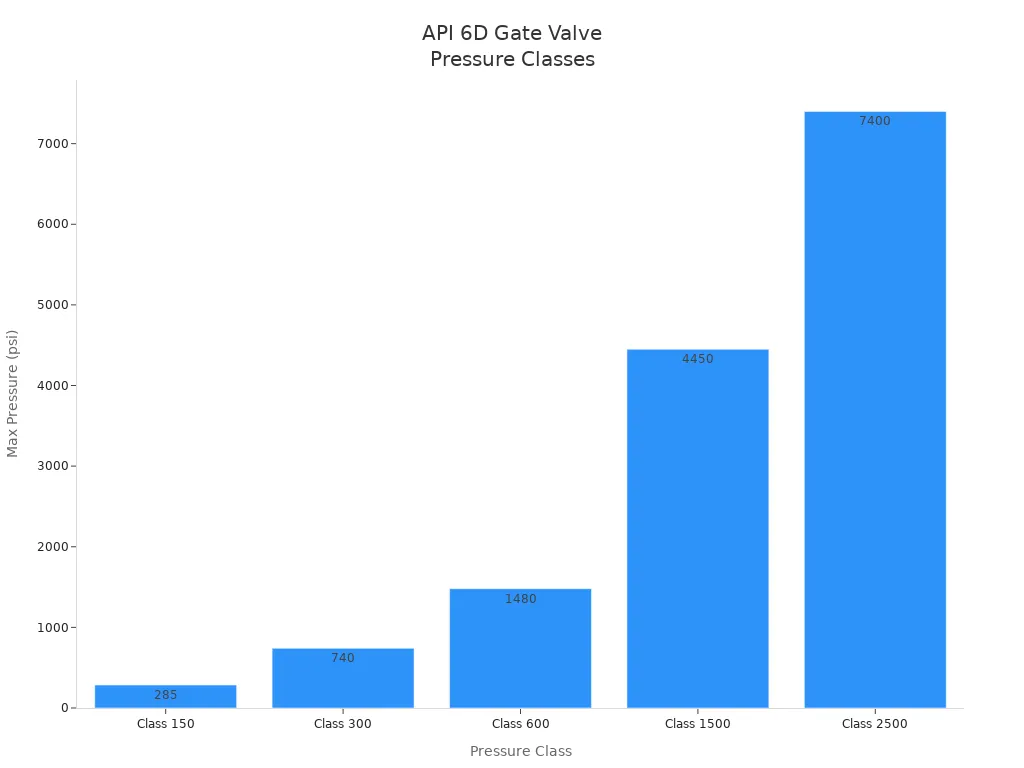
You can see that API 6D gate valves handle many pressures and temperatures. Didtek’s valves meet these standards, so you can trust them in every job.
Tip: Always check the pressure class and sealing type before you pick a valve for your pipeline. This helps you match the valve to your job and keeps your system safe.
You want a valve that works well every time. An api 6d gate valve gives strong performance and is very reliable. The full-bore design lets fluid move easily through the valve. There is almost no pressure drop. This helps your system run smoothly and saves energy. You can see how api 6d valves are special by looking at these main points:
Metric | Description |
|---|---|
Pressure-Temperature Ratings | Handles many pressure classes and temperature ranges for different pipelines. |
Material Integrity | Uses strong materials that resist cracking and damage. |
Testing Protocols | Passes tests for leaks, pressure, and fire safety. |
You can trust these valves to last a long time. They work well even in tough places.
Every job is different, so you need a valve that fits your needs. Didtek gives both OEM and ODM solutions. You can pick special designs, sizes, or materials for your api 6d gate valve. Some choices are pressure-seal bonnets for high pressure or extended bonnets for cold places. The table below shows how different materials change the valve’s life and rust resistance:
Material Type | Corrosion Resistance | Lifespan Impact |
|---|---|---|
Stainless Steel | High | Lasts longer in harsh fluids |
Carbon Steel | Moderate | Needs coatings for longer life |
Alloy Materials | Very High | Works best for long-term use |
You can also choose actuator options, like electric or pneumatic. These make your system easier to use.
You want your pipeline to stay safe. An api 6d gate valve has many safety features. Each valve goes through strict tests for leaks, pressure, and fire safety before leaving the factory. These tests help stop failures and keep your system running. The api 6d standard has high rules for safety and quality. You get a valve that protects your pipeline and makes maintenance simple. Regular checks and easy repairs help you avoid problems and keep your system working well.
Tip: Always check the valve’s safety features and test results before you install it. This helps you keep your operation safe and reliable.
You see api 6d gate valves a lot in oil and gas. These valves help control flow and shut off parts of a pipeline. You need strong valves to stop leaks and keep things safe. Oil and gas pipelines face hard conditions. There can be high pressure, big temperature changes, and strong chemicals. The right valve helps you avoid shutdowns and expensive fixes.
Here is a table that shows the main problems with pipeline valves in oil and gas:
Challenge | Description |
|---|---|
Reliable sealing | Makes sure the valve does not leak. This is important for safety. |
Performance under varying conditions | Must work well with different pressures and flows. This stops shutdowns. |
Material selection | Changes how long the valve lasts and how much care it needs. This matters in tough places. |
You can see api 6d valves help with these problems. They give strong seals and last a long time.
You also find api 6d valves in other industries. These valves work well when you need to control flow and handle tough liquids. Here are some common uses:
Oil and Gas Pipelines: Shut off parts of the pipeline, control flow, and stop backflow when pressure is high.
Petrochemical Industry: Handle strong chemicals and hot liquids.
Power Generation: Control steam, water, and gas in power plants.
Water Treatment: Manage water flow and keep systems working well.
In marine places, api 6d valves give extra safety. These valves fight rust and work well with high pressure and heat. Their strong build and api rules help keep your system safe and working right.
You need api 6d rules to keep your work safe and running well. The api rules make sure your pipeline valves are good quality and work right. When you use api 6d valves, you lower the chance of leaks and problems. This keeps people, machines, and nature safe. You also save time and money because you do not need as many repairs. Picking the right api 6d valves helps you feel safe in oil and gas and other jobs.
You use api 6d gate valves to stop flow in pipelines. These valves let liquid move freely when open. They help stop leaks and keep pipelines safe. Didtek is known for good quality and helpful service. You get safety and steady work from features like strong sealing. Double block and bleed adds extra protection. For new jobs, pick api 6d gate valves. Api standards help keep your system safe for a long time.
Stops flow when needed
Made with good quality
Works well even under pressure
Feature | Benefit |
|---|---|
Strong sealing | Stops leaks and keeps you safe |
High reliability | Lasts long and works well |
API 6D sets the rules for making and testing gate valves. You get a valve that meets strict safety and quality standards. This helps your pipeline work safely and last longer.
You should check your pipeline’s pressure, temperature, and fluid type. Pick a valve that matches these needs. Didtek offers many options, so you can find the right fit.
Yes, you can use API 6D gate valves in water systems. These valves work well in many industries, including water treatment, because they give strong shut-off and resist corrosion.
You should check your gate valve regularly. Look for leaks or wear. Clean and test the valve as part of your routine maintenance to keep your system safe.
Didtek uses strong materials and follows strict tests. You get a valve that resists rust, handles high pressure, and lasts a long time. This means less downtime for your system.


