+86-18058825678
- All
- Product Name
- Product Keyword
- Product Model
- Product Summary
- Product Description
- Multi Field Search

- Home
- Our Product
- About Didtek
- Solutions
- Exhibition Show
- Support
- News
 English

Views: 0 Author: Site Editor Publish Time: 2026-06-13 Origin: Site


You may have to pick between a gate valve vs globe valve when selecting the right valve for your system. Gate valves are best if you want a strong shut-off, while globe valves are better suited for controlling flow. Didtek is a trusted brand for high-quality gate valves, which are widely used in various industries for pipeline shutoff and water systems. For instance, a company in Texas reduced pressure drop by 80% and saved thousands of dollars each year by utilizing gate valves. With clear advice, you can easily choose the right valve for your needs.
When you look at a gate valve vs globe valve, you can see they work in different ways. They are not the same in design, how they work, or what they do best. The table below shows these differences side by side:
Feature | Globe Valve | Gate Valve |
|---|---|---|
Performance/Functionality | Control valves that regulate media flow | Isolate media without regulating flow |
Structure | Complicated structure with internal components | Simpler structure with components on the surface |
Sealing surfaces | Superior seal due to internal valve core | Weaker seal on the surface of the valve disc |
Application | Ideal for high pressure and temperature changes | Suitable for various fluids, sensitive to pressure drops |
You use a gate valve when you want to stop or start the flow all the way. You use a globe valve when you need to control how much fluid moves. The biggest difference is inside the valves. A gate valve has a flat or wedge-shaped disc. This disc moves up and down to open or close the path. This gives the fluid a straight way to go through, so there is not much resistance.
A globe valve has a round body and a plug or disc that moves. You turn the handle to move the disc up or down. This lets you change how much fluid goes through. This design helps you control the flow better, but it also makes more resistance. You will see a bigger pressure drop with a globe valve than with a gate valve.
Here is a quick look at how pressure drop compares:
Valve Type | Pressure Drop (bar) |
|---|---|
Gate Valve | 0.1 |
Globe Valve | 2.0 |
Globe valves usually have a higher pressure drop than gate valves.
For example, a DN100 globe valve in a 10 bar system can cause a 1.5 bar pressure drop. You might need a bigger pump to keep the same flow. This can make your costs go up by 10–15% compared to using a gate valve.
You should also think about how often you need to fix the valves. The chart below shows how often you need to replace parts and how much repairs cost for each type:
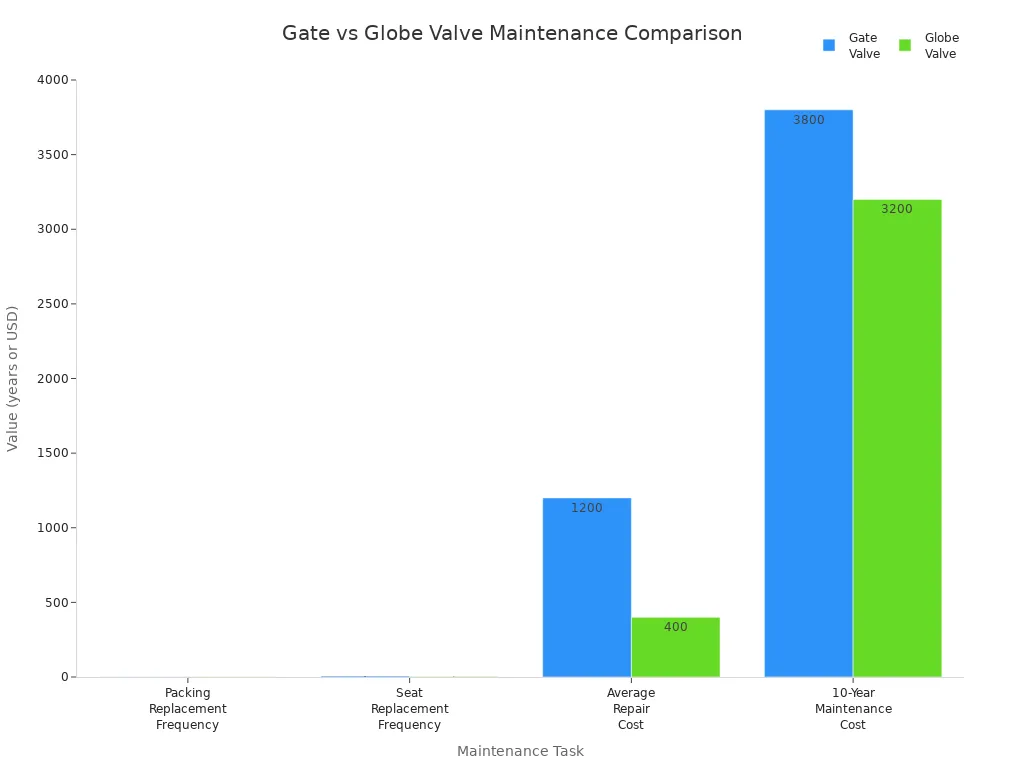
A gate valve does not need new packing or seats as often, but fixing it can cost more. Sometimes you have to take the valve out of the line to repair it. A globe valve needs more repairs, but you can often fix it without removing it.
Tip: If you want low flow resistance and easy shut-off, pick a gate valve. If you need to control the flow exactly, a globe valve is better.
You should choose the right valve for your job. Here is a table that shows where each type works best:
Application | Gate Valve Use Case | Globe Valve Use Case |
|---|---|---|
Water Supply Systems | Gate valves are best for low resistance and flow both ways. | Globe valves are used for controlling water flow in treatment plants. |
Power Plants | Gate valves handle high pressure and heat safely. | Globe valves control steam or feedwater flow with accuracy. |
Chemical Processing | Gate valves work with many fluids, even corrosive ones. | Globe valves regulate chemical dosing and mixing. |
You often see a gate valve in water lines, power plants, and chemical factories. You use it when you want to open or close the flow all the way. You find a globe valve where you need to adjust the flow, like in cooling systems, fuel lines, or process control.
Globe valves are trusted for controlling flow in factories.
They help you control the flow very well.
You use them when you need accuracy and reliability.
Globe valves are also used as control valves with actuators and positioners.
When you compare gate valve vs globe valve, always think about what your system needs. If you want to open or close the flow all the way, use a gate valve. If you need to adjust the flow, use a globe valve. This helps you save energy, lower costs, and keep your system working well.
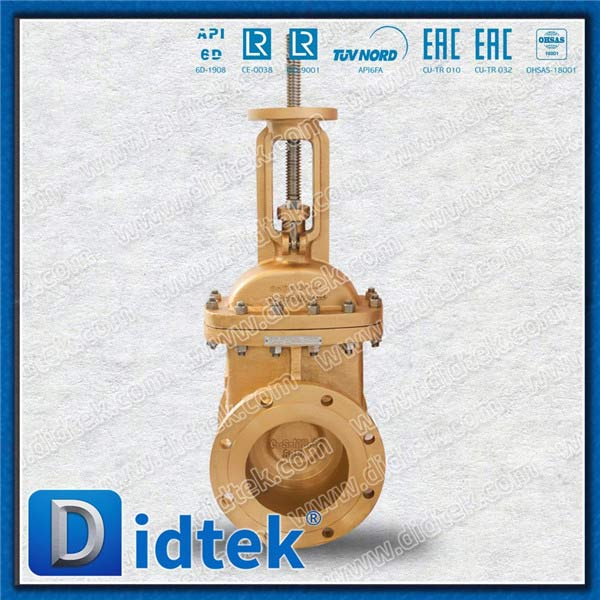
A gate valve is used in many places. It is good for stopping or starting flow. The table below shows where you might use this valve:
Environment/Industry | Description |
|---|---|
Water Supply & Wastewater | Used in city water and sewage plants for shut-off. |
Oil & Gas | Needed for pipeline sections and emergency shutdowns. |
Power Plants | Controls steam, condensate, and cooling water with little pressure loss. |
Industrial & Mining | Handles slurries and rough fluids, helps stop clogs. |
Chemical Processing | Needed for tight shut-off and material compatibility. |
Pharmaceuticals | Gives corrosion resistance and strength for chemicals. |
Marine | Works with salt water and controls ballast or fuel oil on ships. |
Didtek has many types of gate valves. These include Wedge, Long Stem, Pressure Seal, and Slab. You can pick different materials, sizes, and gear types. Didtek also makes custom valves for special jobs.
Gate valves have many good points:
Fluid moves easily because the path is straight.
They save energy since the movement is up and down.
Full-bore design makes cleaning and checking simple.
They work with high pressure and heat, so they are great for oil, gas, and power plants.
Tip: Always look at the pressure rating. ANSI classes tell you the most pressure a valve can take at a certain temperature.
There are some things to watch out for with gate valves:
They are not good for controlling flow or throttling.
If you open them only part way, fast fluid can hit the seats and disc.
This can cause wearing out, shaking, or damage to the seal.
The material matters. Alloy steel is good for high pressure, but cast iron is not.
Temperature and pressure change together. When temperature goes up, the valve can handle less pressure. Always pick a valve that fits your system for safety and good performance.
You can use a globe valve in many places. This valve is good when you need to control fluid flow. People use globe valves for different jobs:
Throttling services need careful flow control.
Steam systems need a strong shut-off.
Cooling water systems need both control and shut-off.
Fuel oil systems need a safe closing part.
Oil and gas pipelines use them for high heat and pressure.
Chemical plants use them for fluids that can corrode.
HVAC systems use them when pressure and temperature change.
A globe valve is smart if you need to control flow exactly. You can set the valve to let just the right amount of fluid through.
Globe valves have many good points for your system. Here are some main benefits:
You can control flow very well and stop water hammer.
The valve closes tightly, so leaks do not happen much.
Globe valves last long because they are made from strong materials.
You can use them with gases, liquids, and slurries.
The design lets you open and close the valve slowly.
This keeps your system safe from sudden changes.
You can set the valve for many flow rates, so it is flexible.
Tip: Check and take care of your globe valve often. This helps it last longer and work better.
There are some things to think about before you pick a globe valve:
Globe valves make more pressure drop than other valves. This can make your system less efficient.
They may need more fixing because they have a complex design.
Globe valves can be bigger and heavier than other valves. This can be a problem in small spaces.
You must pick the right material for your fluid. This stops damage.
Always check if the valve fits the rules for your job.
If you remember these things, you can choose the best globe valve for your needs.
Picking the right valve is not hard. You just need to ask good questions. Avoid mistakes and use a checklist. This section helps you find the best valve for your needs. You can choose shut-off or flow control.
Ask yourself some important questions before picking a valve. These questions help you know your system better. They make sure you choose the best valve:
What is the flow rate in gallons per minute?
What are the pressures when the pump is off and on?
What size is the pipeline?
What kind of media goes through the valve?
Will chemicals be used in the system?
Will the system handle solids? What size are they?
Is there more than one pump in the system?
Is it a header system?
Where does the discharge pipeline go? How far does it run?
Is the discharge line open or closed?
Answer these questions before picking a valve. This helps you avoid problems later.
Many people make mistakes when picking a valve. You can avoid these mistakes if you know what to look for. Here is a table with common mistakes and what they mean:
Common Mistakes in Valve Selection | Description |
|---|---|
Neglecting pressure rating | Not checking the pressure rating can cause bad performance or failure. |
Overlooking materials | Not checking materials can cause problems with the fluid or media. |
Ignoring flow control capabilities | Using the wrong valve for flow control can make your system less efficient. |
Not evaluating installation space | Not measuring space can make it hard to install or fix the valve. |
Failing to consider energy requirements | Not thinking about energy use can raise costs, especially if you need precise throttling. |
You should also avoid these mistakes:
Do not pick a valve just because it matches the pipe size. This can make the valve too big and hard to control.
Make sure the valve works well at normal flow, not just at the highest flow.
Think about risks like high pressure drops, dirty fluids, or corrosive chemicals. Some valves need special features for these problems.
Tip: Always check your system details before picking a valve. This helps you avoid expensive mistakes.
Use this checklist to make sure you check everything important. The table shows what to check, why it matters, and mistakes to avoid:
Feature | Importance | Common Mistakes |
|---|---|---|
Material Quality | Needed for durability and good performance | Not checking for corrosion resistance |
Pressure Rating | Makes sure the valve can handle the system | Underestimating the pressure rating needed |
Size and End Connection | Helps with flow and easy installation | Picking the wrong size or connection type |
Flow Coefficient (Cv) | Shows how much flow the valve can handle | Not looking at Cv values during selection |
Temperature Rating | Must handle the system temperature | Choosing a valve that cannot take the heat |
Check each item before you buy a valve. This helps you pick the right valve for your job.
Note: Use a globe valve for flow control. Use a gate valve for shut-off.
If you follow these tips, you can match the valve to your job. You will avoid common mistakes. This makes picking a valve easy and helps your system work well.
When picking between gate and globe valves, first think about what your system needs. Check how much flow you need and how much energy it uses. Make sure you have enough space to install the valve. Always ask the supplier for test results.
Figure out what your system needs.
Choose the right material for your environment.
Make sure the valve fits your space and meets standards.
Didtek is a good choice for tough or chemical-heavy jobs.
Use the checklist above to help you pick the right valve easily.
Condition | Best Material | Why It Matters |
|---|---|---|
Temperature Extremes | Heat/cold resistant | Works well in tough places |
Corrosive Environments | Stainless steel | Stays strong when used with chemicals |
You use a gate valve for on/off shut-off. You use a globe valve for controlling flow. Gate valves give you low resistance. Globe valves help you adjust flow more precisely.
You should not use a gate valve to regulate flow. Gate valves work best when fully open or closed. Using them halfway can cause damage and leaks.
You should choose a gate valve for high-pressure systems. Gate valves handle high pressure and temperature well. They also give you a tight shut-off.
You need to check your fluid type, temperature, and pressure. Stainless steel works well for chemicals. Cast steel fits most water and oil jobs. Ask your supplier for advice.
You should check your valves every few months. Look for leaks, wear, or buildup. Regular checks help you avoid big problems and keep your system safe.


